

It’s not uncommon for buildings or parks to be named after people. But a wasp?
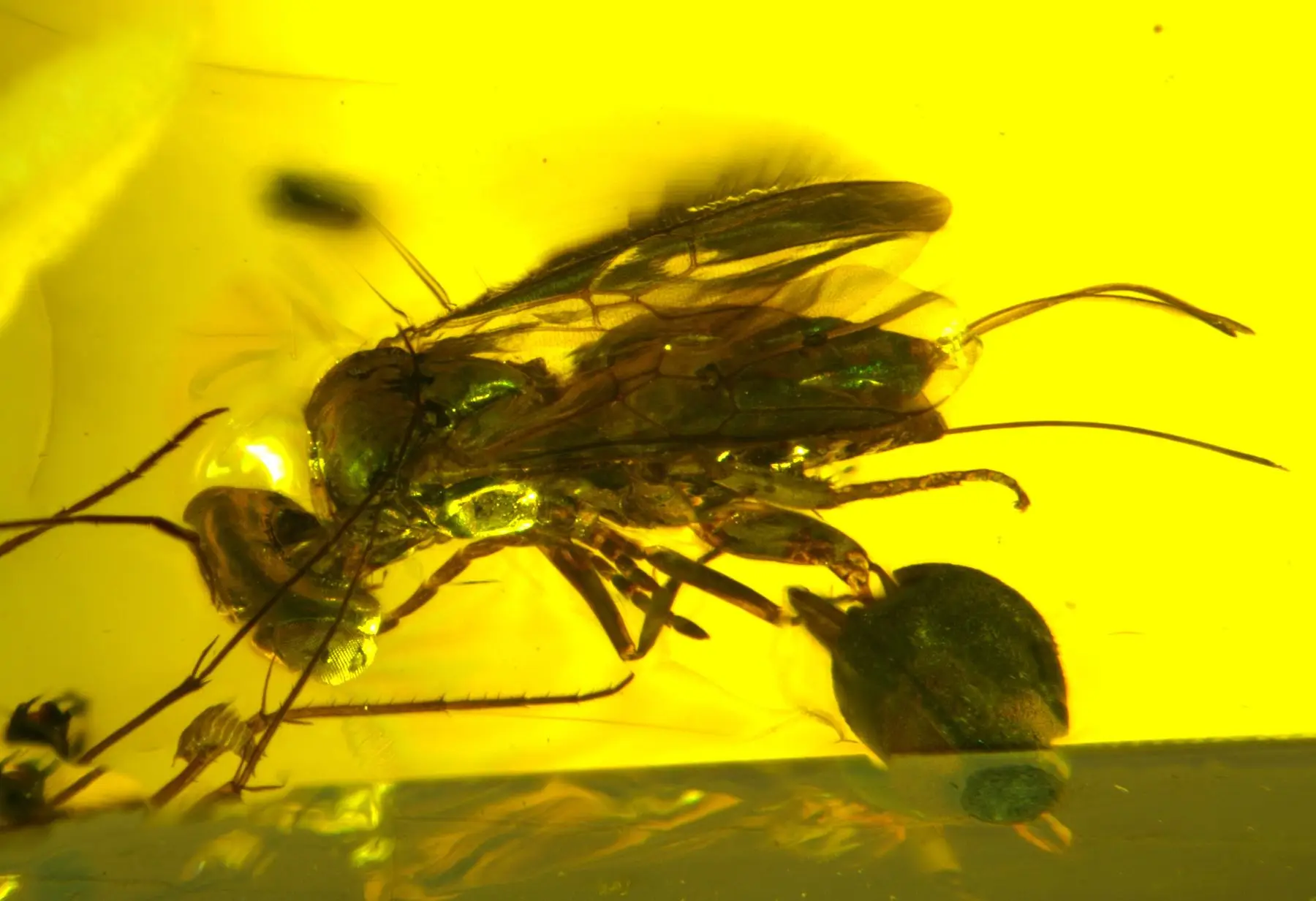
That’s exactly what happened to Scott Shaw, a professor in the University of Wyoming’s Department of Ecosystem Science and Management. A newly discovered ancient wasp species, dubbed Cretolyra shawi, was recently named in Shaw’s honor. The insect came to light in a recently published paper in the journal Arthropod Systematics & Phylogeny.
“I feel very honored to have a 98-million-year-old extinct animal that lived alongside dinosaurs named after me,” says Shaw, who also is the curator for the UW Insect Museum.
Shaw, who has been at UW since 1989, was recognized due to his broad knowledge and published research about insects, with a good share of the previous papers focused on Megalyridae, a family of parasitoid wasps.
“I’ve published nearly 200 scientific studies about insects, and 16 of them were specifically about Megalyridae. In a nutshell, I discovered, described and named half of the living megalyrid genera and more than half of their living species,” Shaw says. “My research on long-tailed wasps makes me the senior living authority on Megalyridae worldwide—hence, the honorary patronymic name.”
His studies of Megalyridae phylogeny, evolution, and biogeography form the basis for the modern tribal classification system for their living species, and this system was adapted to include newly discovered fossil species in the recent paper. His 1990 study on the phylogeny and biogeography of the Megalyridae was the first modern evolutionary analysis for this insect family to include a combined analysis of both living and fossil long-tailed wasp species—and linked their evolutionary patterns to the history of continental drift patterns.
While Shaw was not involved with the most recent work published in Arthropod Systematics & Phylogeny, he has previously worked with two of the paper’s authors. The paper focused on eight new species of parasitoid wasps belonging to the Megalyridae wasp family that were found in late Cretaceous Period ambers.
About the new wasp species, Cretolyra shawi, Shaw says it is a small extinct insect, not quite 3 millimeters long, that was found fossilized in Kachin amber, from Kachin State, Myanmar, formerly Burma. The species once lived in the Cretaceous Period, about 98 million years ago.
“The new species did not fit into any previously known genus, so the new genus, Cretolyra, also was created to accommodate this and one other new species. Based on the known biology of other living Megalyridae wasp species, we assume that this species was probably a parasite of wood-boring beetle larvae in trees,” Shaw says. “This female specimen probably was walking on a tree searching for beetle larvae when it got stuck in some oozing tree sap that eventually fossilized.”
The parts of the genus name refer to the Cretaceous Period—Creto—and the string-like ovipositor of the female wasp—lyra—referring to a lyre, or stringed instrument. In this case, the reference is to the ovipositor, or the wasp’s egg-laying device.
“There are no modern surviving examples of Cretolyra, so if this little wasp had not got stuck in tree sap, fossilized and then, luckily, unearthed 98 million years later—in times when I and other humans are studying its surviving cousins—we never would have known it existed!” Shaw says.
While this marks the first time Shaw has had an extinct wasp species named after him, he has been stung by the name bug previously. And quite often.
“Fifteen other new insects have been named after me before, but all of those are living modern species,” Shaw explains. “This is the first time a fossil insect was named after me, so it was an unexpected surprise and a unique honor.”