

The low, sporadic precipitation and cold, windy climate of the U.S. Northern High Plains present a problem for dryland and irrigated producers in large- and small-scale crop production.
Soils in this region are typically alkaline and low in soil organic matter and soil moisture. The shorter growing season and heavy weed competition threaten crop yields.
Cover crops may be key to addressing these issues, says Elizabeth Moore, assistant lecturer in plant sciences at the University of Wyoming, but not all cover crop species are created equal.
Soils in this region are typically alkaline and low in soil organic matter and soil moisture. The shorter growing season and heavy weed competition often threaten crop yields.
Producers in southeast Wyoming have often planted a cover crop mix of peas and oats to mitigate these challenges, but results are mixed due to poor germination and low biomass production.
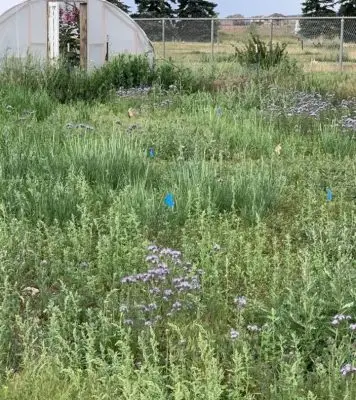
Over the course of the 2020 growing season, Moore experimented with different crop mixes in dryland research plots in Pine Bluffs, Chugwater, and Lingle. She found that cover crop mixes containing high-performing grasses (such as cereal rye or oats) and legume species in equal proportions performed better than mixes dominated by high percentages of legumes.
Legumes establish a beneficial relationship with nitrogen-fixing soil bacteria that provide atmospheric nitrogen to the legume plant. However, legumes can also be more costly than other cover crops. Adding a high-performing legume, such as a vetch or clover, to a mix with a grass and a brassica (a turnip or radish, for example) and a broadleaf, such as a sunflower, may improve soil health and keep costs down.
“Each plant brings something unique to the cover crop mix and they work in a symbiotic relationship,” says Moore. The live roots of cover crops also deposit photosynthates (carbohydrates) into surrounding soils, providing fuel for soil microbes, which benefits the soil ecosystem.
One of the farmer collaborators involved in the project designed a four-species cover crop mix that performed well in a dryland setting. “If cover crop mixes will perform well under dryland settings, then we can just about guarantee they will perform even better under irrigated conditions,” Moore comments.
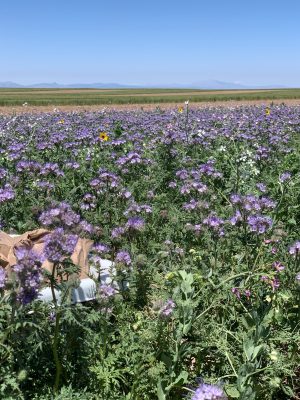
A smaller, irrigated plot in Laramie for specialty crop production showed promising results for Phacelia tanacetifolia, a broadleaf species with high biomass production. This small-seeded plant grew well in early spring and flowered early in the growing season, potentially benefiting pollinator insects.
“Hopefully with this research we have provided some additional cover crop species for farmers to consider,” says Moore. “Whenever we ask them to limit tillage, we want to provide some good alternatives for the producers to try. We aren’t saying cover crops are the golden key, we are saying it’s a good tool in our tool bag that helps us be good stewards of the land.”
To learn more, contact Moore at emoore24@uwyo.edu or (307) 766-3111.
This article was originally published in the 2023 issue of Reflections, the annual research magazine published by the UW College of Agriculture, Life Sciences and Natural Resources.