


Wyoming may be well positioned to capitalize on the growing demand for products made with ancient grains, a new study by the University of Wyoming Extension suggests.
The publication, titled “Growing Einkorn, Emmer, and Spelt in Wyoming,” analyzes the results of four years of trials conducted on Wyoming farms and agricultural experiment stations. These experiments tested the viability of producing three types of ancient wheat suitable for Wyoming growing conditions.
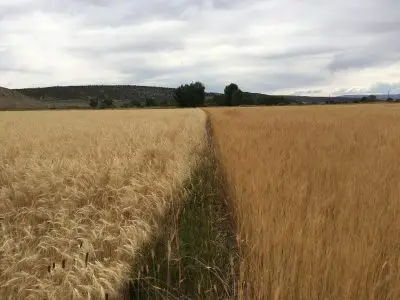
“These ancient grains provide an alternative to malt barley and wheat grown in the Bighorn Basin and in southeast Wyoming,” says Caitlin Youngquist, UW Extension educator and co-author of the publication. “It gives farmers another choice for cash crops.”
Wyoming farmers already grow 250,000 acres of wheat, oats and barley. Ancient wheats like einkorn, emmer and spelt can be incorporated into current crop rotations and grown with existing equipment.
While ancient grains have been plunged back into the spotlight recently, these crops are also part of Wyoming’s history. In the early 1900s, Worland was home to an emmer breakfast cereal factory, the authors note.
Ancient grains typically have higher protein content than most modern wheat varieties and can be used for baking, cooking, and even brewing beer.
Einkorn, emmer and spelt are taller than modern varieties, with more robust roots and greater leaf area. Farmers in the Bighorn Basin found that emmer and spelt require less water than malt barley, likely due to these larger root systems.
The height of these plants also means that they produce very high-quality straw, a secondary marketable product, says Youngquist. Results suggested that emmer and spelt are viable as forage and fodder crops in Wyoming.
Like anything, the authors acknowledge, ancient grains have drawbacks. For instance, most ancient wheat varieties are not free threshing, which means they require additional post-harvest processing. In the research trials, a de-huller at PREC was used to complete this step.
However, despite potential challenges, the authors conclude that ancient grains offer promising options to diversify crops and revenue in Wyoming.
To download a free copy of the publication, visit https://bit.ly/wy-ancient-grains.