

UW collaborates in $10 million project to study diverse perennial forage systems

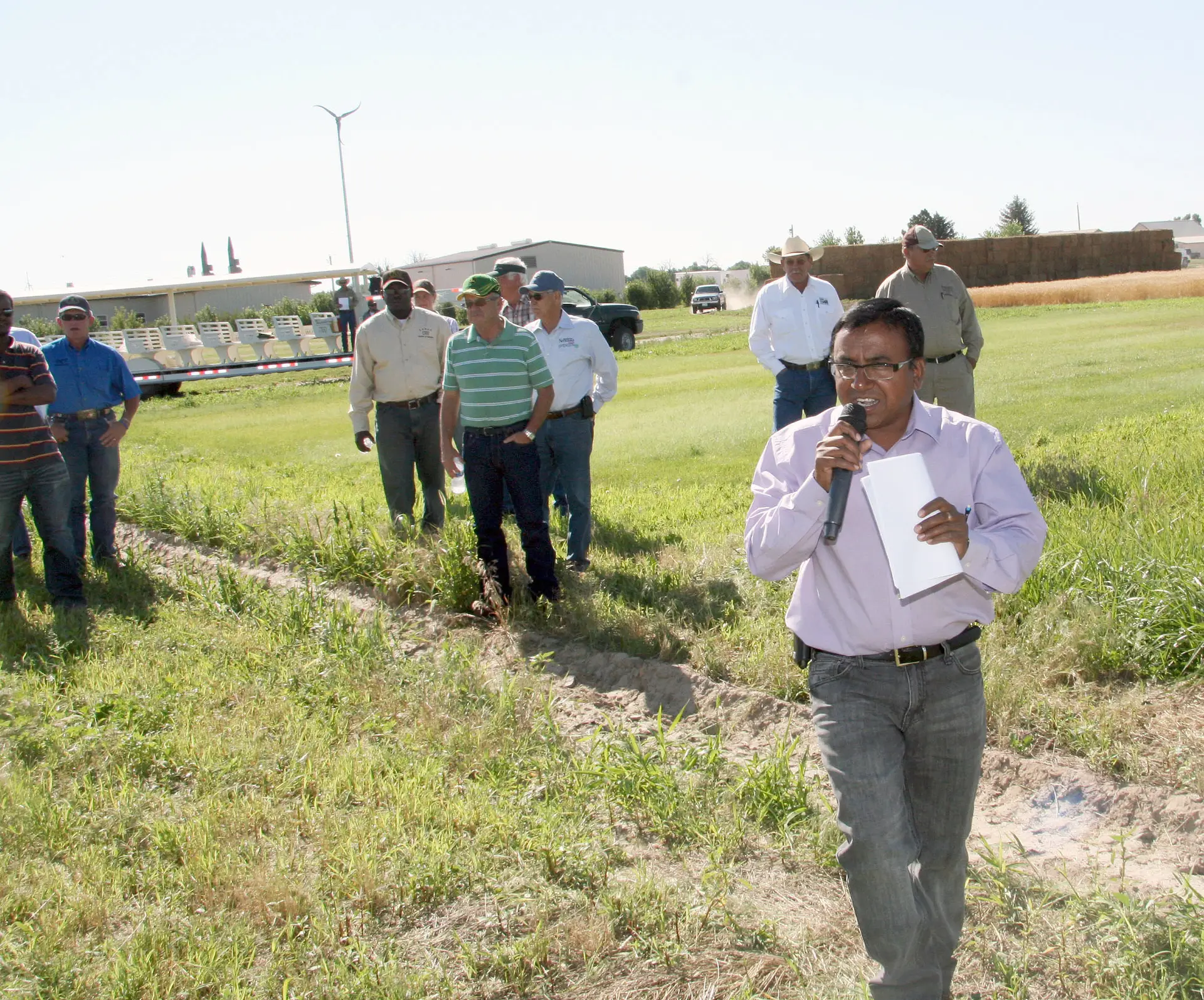
People standing in grass field
UW Extension agroecologist Anowar Islam describes research at the James C. Hageman Sustainable Agriculture Research and Extension Center near Lingle.

University of Wyoming scientists are a part of a multi-state team launching research into perennial forage systems and help promote their adoption.

UW will serve as a research hub site for western states to collect, organize and analyze soil samples.

“We will measure and compare numerous production, environmental, social and economic factors,” said Anowar Islam, UW Extension forage agroecologist. “UW will play an important role in initiating and executing this highly relevant and timely project.”

The project involves more than 50 researchers and stakeholders from 23 universities, two USDA-Agricultural Research Service centers, and 12 farmer organizations, industry groups, non-governmental organizations and government agencies, said Islam, a professor in the Department of Plant Sciences.

Funding is through a $10 million grant from the USDA National Institute of Food and Agriculture.

Prevailing agricultural systems in the U.S. are dominated by annual crop monocultures that lack resilience to extreme weather and are challenged by soil erosion and other environmental issues, said project director Valentin Picasso, associate professor in the University of Wisconsin–Madison Department of Agronomy.

“Through this new project, we hope to promote the transformation of the landscape to be more resilient, by integrating more perennial crops and forages with livestock,” he said.

Part of the effort involves a nationwide network of 50 farm pairs—one farm already using diverse perennial forage systems paired with one interested in transitioning toward more diverse perennial systems—that represent all of the major agro-ecoregions of the United States.

The team will share results through outreach and education materials throughout the five-year term of the award.

UW will also serve as one of the three coordinators (with Maryland and New York) of the education program to:

* Recruit and instruct high school teachers and summer undergraduate student interns on diverse perennial circular systems, resilience, economic services and economic value,

* Develop curriculum materials for K-12 student education, and

* Partner with local community entities and projects to create learning programs and opportunities.

For more information, contact Islam at mislam@uwyo.edu or 307-766-4151.
Share the Post:

Related Posts

Artist booth at an Ag & Art Tour event, where a local artist displays watercolor paintings and handmade prints while engaging with a visitor; set outdoors with rural landscape, showcasing the connection between agriculture, creativity, and community.

UW Extension to Host Ag & Art Tour in Natrona County

For those interested in connecting with local artists and agriculturalists, the University of Wyoming Extension will lead a series of free self-guided Ag & Art tours from May through September.
The first Ag & Art event takes place in Natrona County Saturday, May 16, from 10 a.m. to 2 p.m.
“We had a great season last year and are excited to bring this event to five counties this summer, kicking things off [in] Natrona County,” says Hailey Sorg, Wyoming’s Jay Kemmerer Outdoor Recreation, Tourism and Hospitality (WORTH) Institute extension educator.

Read More
Amy Storey, a University of Wyoming third-year master’s student in zoology and physiology, completes a field survey for a collection site in Grand Teton National Park. This included taking habitat measurements about the floral and bee community as well as collecting environmental data, such as wind speed and land use. Storey’s presentation, titled “Parasites and Bumble Bee Decline in Wyoming,” was named the winning entry for a master’s student at the Wyoming Chapter of the Wildlife Society meeting in Sheridan April 8. (Rebecca Armentrout Photo)

UW’s Storey Makes Winning Presentation at Wyoming Chapter of Wildlife Society Meeting

Wild bumble bees are in decline, and various parasites may be a major cause. But there hasn’t been any data on whether Wyoming bees have parasites and to what degree—until now.
Amy Storey, a University of Wyoming third-year master’s student in zoology and physiology, shed light on her research when she took center stage at the recent Wyoming Chapter of the Wildlife Society meeting in Sheridan.

Read More

Help us improve this website!

We’re working to make AgNews easier to use and more useful for you. This quick survey takes about 1–2 minutes.