


Autoimmune diseases like rheumatoid arthritis transform the body’s immune system from protector to attacker, often causing painful long-term symptoms.
As rheumatoid arthritis (RA) progresses, it leads to increasingly severe joint inflammation, which can result in permanent damage. Currently, there’s no cure for the disease. Although treatments can be effective if started early, many patients go undiagnosed until their joints are severely affected.
But RA doesn’t originate in the joints. In the past decade, scientists have established that the autoimmune responses associated with RA start in mucosal sites in the body, such as the lining of the lungs, mouth, digestive tract—and, potentially, the female reproductive tract. These abnormalities, which appear well before patients experience joint inflammation, may be the key to an earlier diagnosis and, ultimately, more effective treatments.

Diagnosing RA in women
Women are disproportionately affected by RA, accounting for approximately 70% of patients. They also tend to develop RA at a younger age and have worse health outcomes.
However, until recently, most research focused on the disease’s progression in men. Studies conducted in UW Associate Professor Brian Cherrington’s lab were among the first to identify early indicators of RA in the female reproductive tract, a discovery that may help explain why women are more likely to contract the disease.
Building on this research, PhD student Ari Sequoia and colleagues in the Cherrington lab are working to better understand how the disease progresses through women’s bodies. They’re also developing a new test that could help diagnose female patients earlier and potentially remove some of the barriers preventing women in rural areas from accessing diagnostic testing.
Enzymes, proteins, and antibodies
Autoimmune diseases like RA play nasty tricks on the body’s immune system, causing it to treat healthy biological structures like foreign invaders.
With RA, the breakdown can start with a process called citrullination, in which special PAD (peptidylarginine deiminase) enzymes cause a molecular change that transforms certain positively charged proteins into neutrally charged proteins.
That might not seem very significant and, in someone who isn’t at risk for RA, it’s a benign process. But for someone developing RA, the change renders the now-citrullinated proteins unrecognizable to the body’s immune system, prompting the formation of anti-citrullinated protein antibodies (ACPAs). Rather than protecting the body from an outside invader like a virus, these antibodies mistake citrullinated proteins for unwanted interlopers and attack them.
These ACPAs and the specific citrullinated proteins they attack may provide the key to understanding RA’s progression in women.

Collaborative research
Sequoia is studying PAD enzymes, citrullinated proteins, and ACPAs in mice. She’s also working closely with Kristen Demoruelle, an associate professor of rheumatology at the University of Colorado Anschutz who has been gathering RA-related data from human patients since 2018.
This side-by-side approach has provided opportunities for both teams to further their research. As Demoruelle’s team at CU Anschutz has discovered new clues about RA pathology in humans, Sequoia has identified similar patterns in mice (and vice versa).
Over the past eight years, the CU Anschutz researchers have gathered reproductive tract fluid from healthy, at-risk, and RA-positive women, analyzing samples for specific enzymes, citrullinated proteins, and ACPAs. These biomarkers may prove instrumental in developing earlier and more effective diagnostic tests for at-risk women.
Since female patients are misdiagnosed more often than their male counterparts, researchers hypothesized that RA may be linked to different citrullinated proteins in women than in men.
So far, results suggest this may be the case in both women and mice.
Over the course of the ongoing, multi-year study, Demoruelle’s team also found that levels of ACPAs in reproductive fluid samples from RA-positive women were significantly elevated compared to samples from both at-risk women and healthy “controls.” Developing a test that utilizes these ACPAs and female specific citrullinated proteins could help detect the disease earlier and more reliably in women.
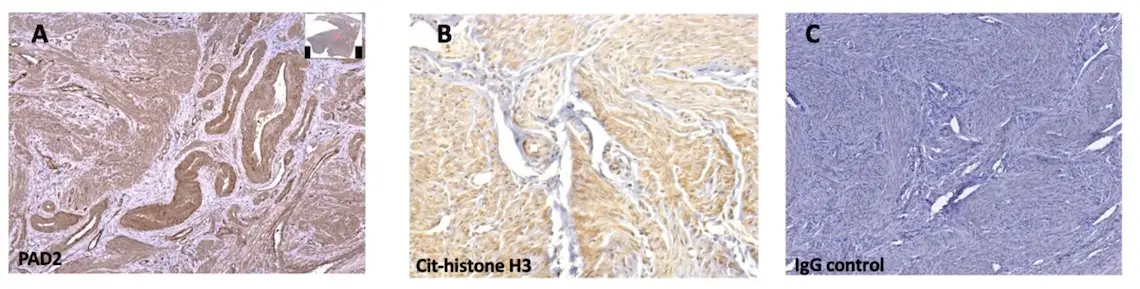
Biomarkers in mice
Unlike humans, mice don’t naturally develop RA. But Sequoia’s lab experiments indicate that the same biomarkers—specific citrullinated proteins, PAD enzymes, and anti-citrullinated protein antibodies—present in human samples are identifiable in mice as well.
Next, she’ll perform tests in mice that have been genetically modified to mimic the symptoms of humans with RA. Studying mice that experience similar symptoms and disease progression provides an opportunity to test potential diagnostic tools and, ultimately, therapeutic treatments before clinical trials begin in human patients.
“The huge end goal is that hopefully, based on these studies and all the [citrullinated] proteins and the mechanisms that we find, we can also help design diagnostic tests or drugs that focus on women’s physiology,” Sequoia comments.
A new type of test
Currently, most diagnostic tests for RA rely on biological markers that show up in blood samples. These tests allow doctors to detect the disease before it targets the joints, but after the ACPAs have begun to spread. Ideally, tests would detect ACPAs before they spread from their origins in mucosal sites like the reproductive tract into the bloodstream and then to the joints.
Researchers have already established that ACPAs are detectable in mucosal sites like the lining of the lungs, mouth, and digestive tract three to five years before RA biomarkers are detectable via blood tests. Recent discoveries at CU Anschutz suggest that ACPAs begin increasing in the female reproductive tract before a woman even develops the disease.
The diagnostic tests that Sequoia is helping develop have the potential to detect RA much earlier by measuring the prevalence of different citrullinated proteins and antibodies before they even enter the bloodstream. Especially since existing tests tend to be less effective in women, these new tools could ultimately revolutionize how the disease is diagnosed and treated in female patients.
A win for Wyoming women
In a rural state like Wyoming, it can be challenging—and expensive—for people with RA to access specialized medical treatments, or even to get a diagnostic test. Unfortunately, it’s not unusual for patients to go undiagnosed or untreated.
But the test Sequoia and her collaborators are developing could potentially eliminate the need for at-risk women to travel to a faraway city just for initial diagnostics.
Instead, a patient could complete the self-collection process at a local clinic and their primary care provider could send the sample to a specialized lab. Ultimately, it might even be possible for rural patients to collect their own samples at home and mail them in directly.
Primary care providers and lab technicians likely wouldn’t have to worry about specialized sample storage either—which can be a challenge, especially in rural locations. Unlike blood samples, the reproductive tract samples from both mice and humans have proved to be quite stable. The samples don’t have to be frozen immediately, and once they’re frozen, they’re stable for multiple years, Sequoia reports.
Especially for at-risk women, an accessible early diagnostic test could help prevent severe symptoms and reduce medical costs. “By detecting RA earlier, we can help patients begin treatment earlier, reduce health care costs, and improve the quality of life for those affected by this challenging disease,” Sequoia comments.
To learn more, contact faculty adviser Brian Cherrington at bcherrin@uwyo.edu.
This article was originally published in the 2026 issue of Reflections, the annual research magazine published by the UW College of Agriculture, Life Sciences and Natural Resources.