

Sainfoin (SAN-foyn) is a perennial legume that boasts high nutrition, drought tolerance, and winter hardiness.
Introduced into northern Wyoming in 1974, sainfoin, Onobrychis viciifolia, has been a management option for livestock managers and producers wanting to windrow or strip graze since it does not cause bloat if eaten while actively growing (see ‘Causes of bloat’, page 15). Sainfoin as hay is often preferred by cattle and sheep over alfalfa.
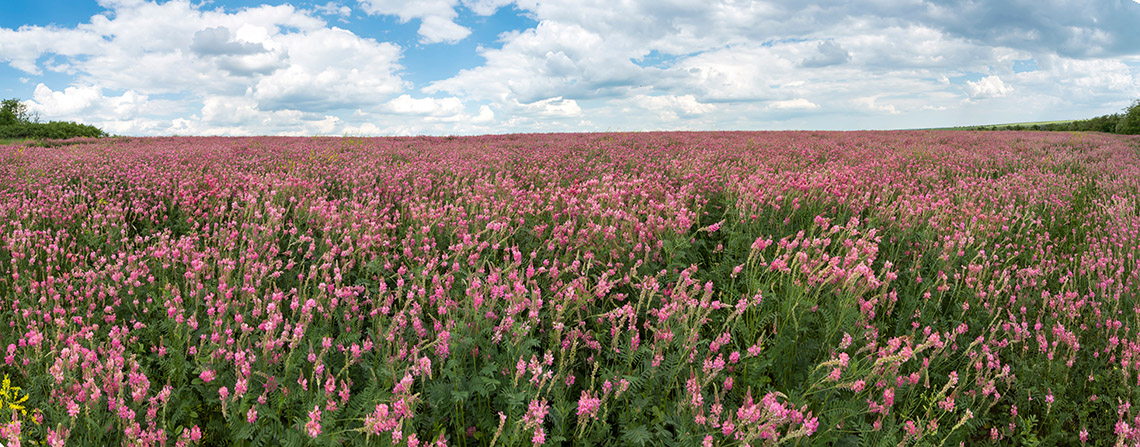
Planting a strip of sainfoin close to other crops, orchards, or beehives can increase production of those crops due to enhanced pollination. Sainfoin displays colorful pink and light purple to white-colored flowers prized by pollinators and produces copious amounts of nectar. Some suggest sainfoin generates more honey production than alfalfa or similar crops, which has earned it the nickname “the honey crop.”
Growth habits
The plant’s deep taproot helps provide tolerance to dryland and droughty areas and it works well as a companion plant when mixed with other forages such as Russian wildrye, meadow bromegrass, birdsfoot trefoil, or orchardgrass.
Sainfoin grows in an upright manner with pinnately compound leaves climbing up the stems. The erect growth habit with tightly attached leaves makes excellent, clean, and easy-to-harvest hay crops. The first year’s hay yield usually exceeds alfalfa production, but production tends to decrease after that.
Reaching 8-36 inches high, this crop forms dense communities that can be used to crowd out problem plants like foxtail barley. Sainfoin does not easily become a weed in western environments. Sainfoin does have similar physical characteristics (pinnate leaves and similarly shaped showy flowers) to locoweed and crazyweed. Educating neighbors, family members, and others about sainfoin is recommended so they know it is not a toxic plant.
Sainfoin is not very productive in soils with high water tables or consistently wet soils. Sainfoin can be planted in spring or fall at 34 pounds of seed per acre alone or used in a seed mix at 2-5 pounds per acre with a grass mixture. It should be allowed to establish for one to two years and only grazed in dormancy until established.
Although a perennial, annual regrowth is limited after haying or grazing. Sainfoin averages about 90 percent of the protein value of alfalfa and greens up earlier than alfalfa and stays green most of the summer. This makes it a prime crop for land reclamation mixes since it tolerates soils with a 6.6 to 8.0 pH.
Varieties available in Wyoming
The seed is more expensive than other legumes. Common varieties planted in Wyoming include ‘Melrose’ or ‘Nova’ from Canada and ‘Remount’ developed by Montana State University. The University of Wyoming helped develop the ‘Shoshone’ variety, which has enhanced resistance to root nematodes.
Most commercial seed dealers have varieties available, and numerous academic studies have been completed on the species since 1971.
To view sainfoin trial results, go to bit.ly/sainfoin-research.
For growth habits and plant characteristics, please see bit.ly/sainfoin-characteristics.
To view the USDA Plant Fact Sheet, go to bit.ly/sainfoin-factsheet.
Scott Cotton is a University of Wyoming Extension educator based in Natrona County and also serving Converse and Niobrara counties. He can be reached at (307) 235-9400 or at secotton@natronacounty-wy.gov.