

You’ve probably seen or heard of people using drones for tasks ranging from aerial photography and film production to firefighting and search-and-rescue missions. Maybe you’ve even flown one yourself.
In the hands of UW researchers, unmanned aerial vehicles (UAVs) are also advancing plant breeding experiments. Led by Donna Harris, assistant professor of plant breeding and genetics in the Department of Plant Sciences, a team of scientists is using drones to help speed the development of soybean and dry bean varieties.
For soybeans, the team is working to develop UAV-based methods to assess drought tolerance. In dry beans, they are examining whether canopy temperature can be used as a fast method to predict the potential yield of different varieties prior to harvest.
Data collection with drones
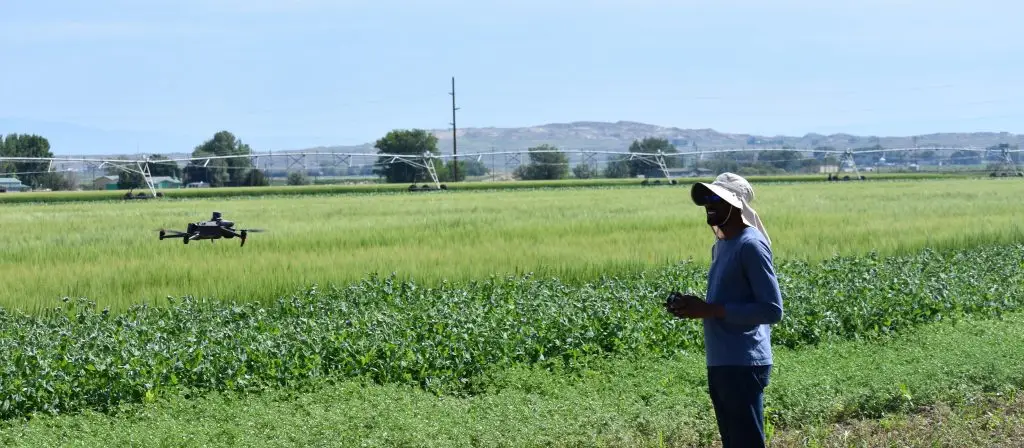
Currently, Harris’s team employs two types of drones: a thermal sensor drone that records the temperatures of plant canopies and a multispectral drone that can detect subtle discolorations in the plants that might not be visible to the human eye.
The multispectral drone allows researchers to assess vegetation indices, which quantify plant health and growth. Normalized difference vegetation index (NDVI) values, for example, allow researchers to evaluate vegetation health (greenness) and density by measuring the difference between near-infrared and red light. NDVI and other vegetation indices can help predict whether a particular variety will tolerate drought conditions.
The thermal drone detects infrared radiation and captures thermal images showing temperature variation among plants. “With that drone, we are able to fly over all our research plots and acquire temperature readings on a plot-by-plot basis,” explains Price Akiina, a PhD student in Harris’s lab. “It gives us an idea of the variation in canopy temperature across plots.”
Harris’s team still uses handheld instruments to check these parameters as well, but they’ve found it’s much faster and more accurate to use the drones—especially when the experiment involves more than 600 plots of soybean plants.
Canopy temperature and yield
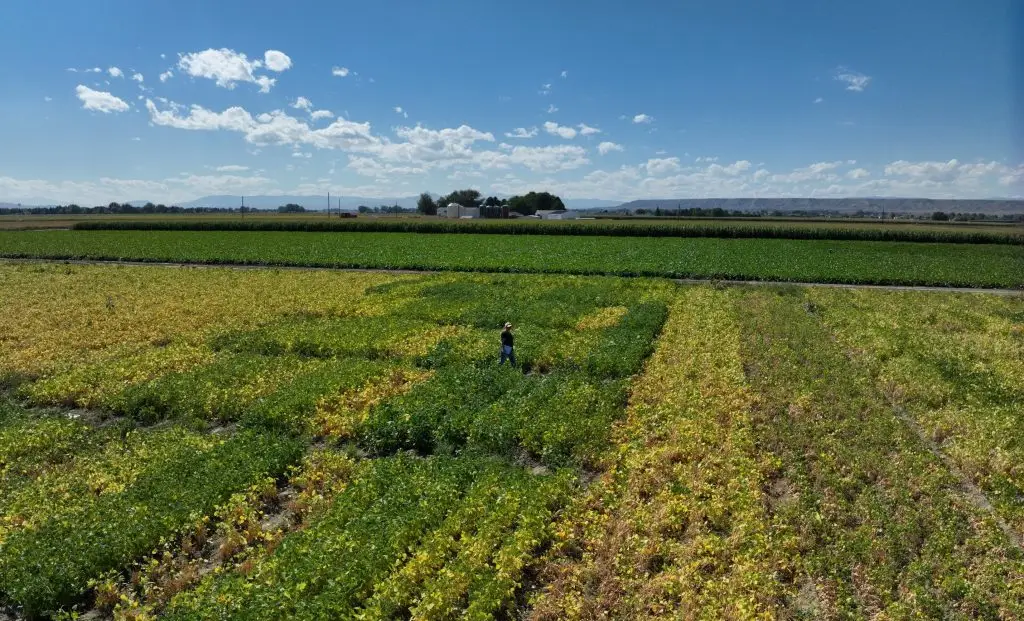
Harris’s lab group first used drones to study temperature and yield in dry beans. Previous research on other crops had identified a negative correlation between the plants’ canopy temperature and yield. Higher canopy temperatures were associated with lower yield and lower canopy temperatures were associated with higher yield.
In a study funded by the Wyoming Bean Commission, Harris and her colleagues set out to determine if this correlation held true for dry beans. “Is there a way we can predict yield without having to go into the field and combine every plot?” she wondered. “Can we go in and look at varieties we haven’t tested before and be able to predict yield based purely off canopy temperature?”
Starting in 2022, Harris’s team collected three seasons of field data at UW’s research and extension centers in Sheridan and Powell. Over the past three years, they’ve examined canopy temperature and yield in 17 varieties of dry beans with different maturity rates.
So far, their results suggest that yes, canopy temperature and yield are correlated in commercial dry bean varieties currently on the market. Across all the varieties, the correlation between canopy temperature and yield has been as high as 84%, though the strength of correlation has varied based on the year and location.
The team’s results suggest that plant breeders may be able to use canopy temperature to determine which varieties should advance to the next year of yield testing. If only the varieties with the highest yield were selected and harvested, time and cost—the two biggest challenges in a breeding program—could be significantly reduced.
However, Harris cautions, more research is needed to determine the optimal timing for data collection and whether adding vegetation indices could improve the model.
Slow-wilting soybeans
While Harris gathered dry bean data in Wyoming, a fellow plant breeder was investigating soybean varieties in Georgia.
Zenglu Li, a professor of soybean breeding and genetics at the University of Georgia, has been studying promising soybean lines with a desirable slow-wilting trait. “That means that in the field, when all the normal soybean varieties are wilting from lack of water, this particular variety will not wilt,” Harris explains. “It can withstand a lot of drought conditions before it will begin to wilt.”
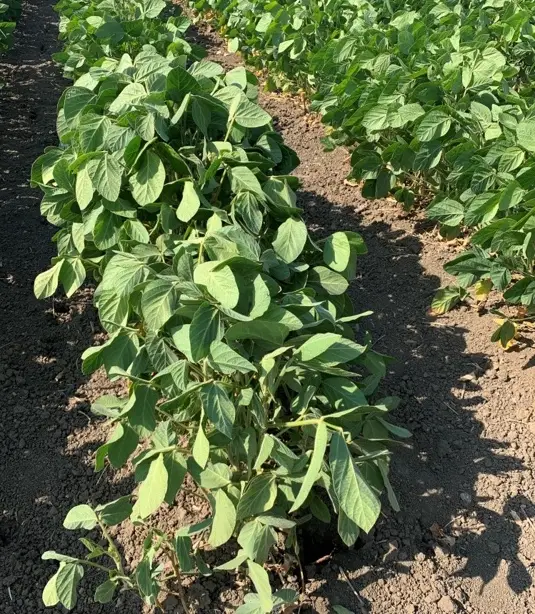
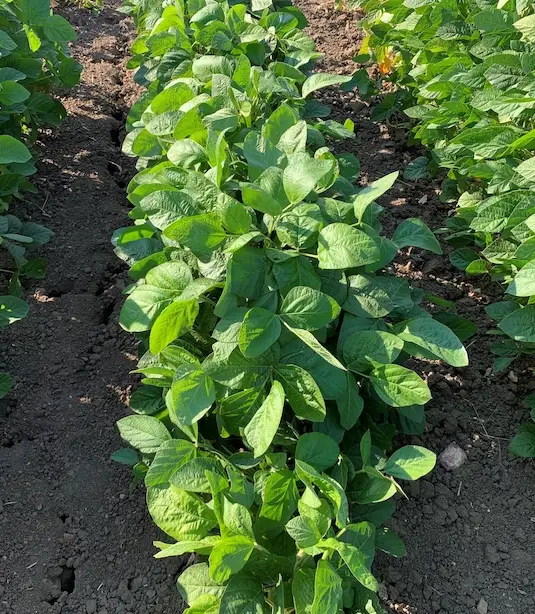
But Li had a problem: it was difficult to properly simulate drought conditions in Georgia’s humid climate. Fortunately, Harris was happy to help, setting up a study site at the Sheridan R&E Center’s Wyarno Farm, a dryland farm with no irrigation.
Initially, Li asked the UW team to collect canopy-wilting data. Typically, this kind of analysis requires visiting individual field plots and estimating the percentage of plants wilted, with zero denoting no visible wilting and 100% indicating all of the plants wilted completely.
Considering her lab’s recent success with using drones for data collection, Harris wondered if it might be more efficient—and potentially more accurate—to employ drones for this type of work.
In partnership with UGA, Harris’s team piloted a new method for gathering canopy-wilting data. They also discovered a positive correlation between canopy temperature and canopy wilting, suggesting that canopy temperature could potentially act as a proxy for canopy wilting.
Going forward, using temperature as a proxy for wilting will allow researchers to more efficiently eliminate varieties that perform worst in drought conditions and concentrate their efforts on the most promising lines.
Images from the drones were also run through a machine learning (ML) model. Sixty-six percent of the time, the model accurately predicted canopy wilting scores using images collected by the drones. These estimates will continue to become more accurate as the researchers add data to the ML model, Harris notes.
“It’s going to be huge for plant breeders,” she says. “We can use a combination of plot images from the drone, as well as multispectral and canopy temperature data, to determine how drought resistant a particular variety might be.”

The genetics of drought tolerance
Li’s lab had already identified regions of the soybean genome that may contain genes related to the coveted slow canopy-wilting trait. The next step is to look at specific proteins and genes in these regions to understand the underlying mechanisms.
“The slow canopy-wilting line may not necessarily be a very appealing line for a farmer to grow,” Harris explains. “It’s probably not your highest-yielding line, and it’s definitely not going to fit every maturity group that farmers grow across the U.S. Our main goal is to find those genes that are involved and then quickly move those genes through cross-pollination into high-yielding varieties for farmers.”
UW PhD student Clement Nyam is leading the investigation at a molecular level. His project involves exposing slow and fast canopy-wilting soybeans to drought conditions and identifying genetic differences in how they respond to stress. To figure out which genes are involved in drought response, he’ll take RNA samples at different time points in the canopy-wilting process, comparing changes in gene activities in the slow canopy-wilting variety versus the fast canopy-wilting variety. Ultimately, observing differences in how the two varieties respond will help him identify which genes influence the wilting rate.
One step “downstream” from the RNA level, postdoctoral researcher Ilyas Ahmad will apply similar research methods to identify proteins regulating the slow canopy-wilting trait. Observing differences in protein abundance as the slow and fast canopy-wilting lines undergo stress testing will allow him to determine which proteins might be associated with the slow canopy-wilting trait.
Better understanding both the genes and proteins associated with slow canopy wilting will ultimately allow the researchers to develop new varieties of drought-tolerant soybeans.
Much remains to be discovered, but heading into the field season, one thing is certain: drones will play a key role in the plant breeders’ success.
To learn more, contact Harris at donna.harris@uwyo.edu.
This article was originally published in the 2025 issue of Reflections, the annual research magazine published by the UW College of Agriculture, Life Sciences and Natural Resources.