

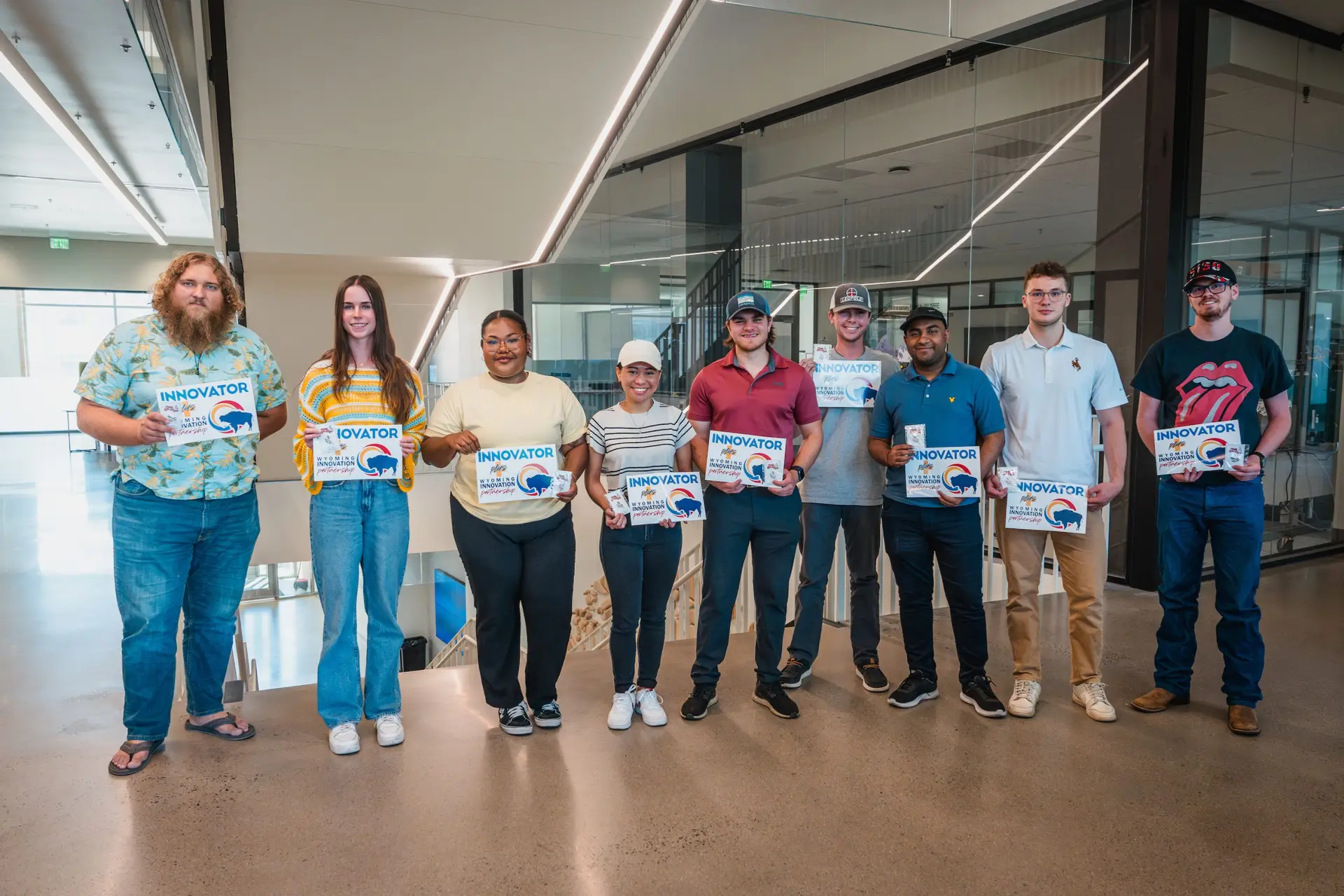
This summer, the University of Wyoming launched its first controlled environment agriculture class.
Controlled environment agriculture (CEA), at its most basic, is producing food indoors. It involves facilities ranging from standard greenhouses to hydroponic vertical farming complexes. The new summer course, funded by the Wyoming Innovation Partnership (WIP), offered a unique opportunity to start building a skilled workforce in CEA for the state of Wyoming.
“This course offered a multidisciplinary approach to the CEA industry, which is highly appealing for aspiring entrepreneurs like me,” says Romy Agrawal, a student in UW’s computer science master’s program.
The CEA course was coordinated by Carmela Rosaria Guadagno, associate director of the UW CEA Center and director of the Plant Growth and Phenotyping Facility. A team of faculty members from several departments on campus helped teach and planned lab activities for the class. Departments included Electrical Engineering and Computer Science, Botany, Plant Sciences, Family and Consumer Sciences, and Accounting and Finances, as well as the School of Computing, the Center for Blockchain and Digital Innovation, and the Science Initiative.
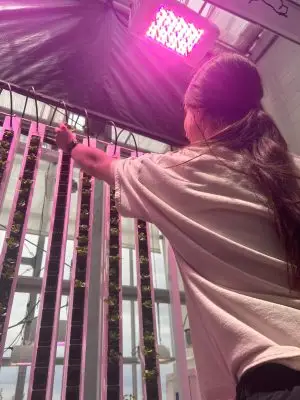
The class hosted lectures from UW faculty and staff members, Wyoming CEA business representatives and collaborating institutions. Students gained hands-on experience in CEA by following the growth of plants in hydroponic vertical towers from seeding to harvesting and deploying different kinds of soilless systems in the UW’s Science Initiative greenhouses. Students also developed individual projects related to CEA with hosting labs around campus. Finally, the class partnered with Plenty, a vertical farming business based in Laramie, where the students were exposed to the entire production cycle of hydroponically grown produce and met with industry researchers during a two-week internship.
Nine undergraduates and one graduate student in fields from agricultural economics to petroleum engineering participated in the new course. “We got a very diverse group of individuals that largely knew nothing about the industry or how their areas of study might be relevant,” says Mike Baldwin, facility manager for the Plant Growth and Phenotyping Facility, who served as co-instructor and lab coordinator for the course. “Coming out of it, more and more, the students are getting a feel for the diversity of jobs and roles within the industry, how these skillsets are applicable across the board.”
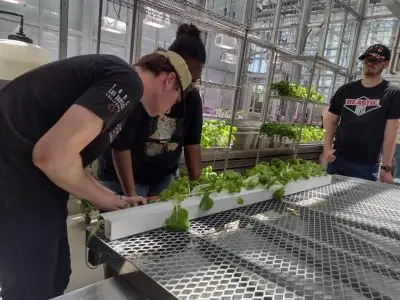
Following the class, several students were hired across campus to continue work on research projects. The course’s teaching assistant, Isaiah Spiegelberg, will continue his studies with Guadagno as a master’s student pursuing further opportunities in CEA. The class has also sparked several interdepartmental collaborations between faculty members.
Jack McKinley, a sophomore in the School of Energy Resources, says, “With everything I’ve learned in this class, when I graduate, I will look for open positions with companies like Plenty, rather than just jobs in the energy sector.”
The course’s impact extends beyond the university as well: already, two Wyoming businesses expressed interest in hiring students who have taken the class.
Guadagno believes this course could expand Wyoming’s capacity to conduct cutting-edge, multi-disciplinary research. “The class actually made [the students] feel different, not just about CEA, but about Wyoming and potential job opportunities in the state,” she says.
Guadagno and her fellow collaborators plan to teach the course again next summer and integrate it with other CEA efforts around campus. The course will be open to community college students as part of the Wyoming Innovation Partnership program efforts to support Wyoming workforce development in CEA.
For more information, contact Guadagno at cguadagn@uwyo.edu.