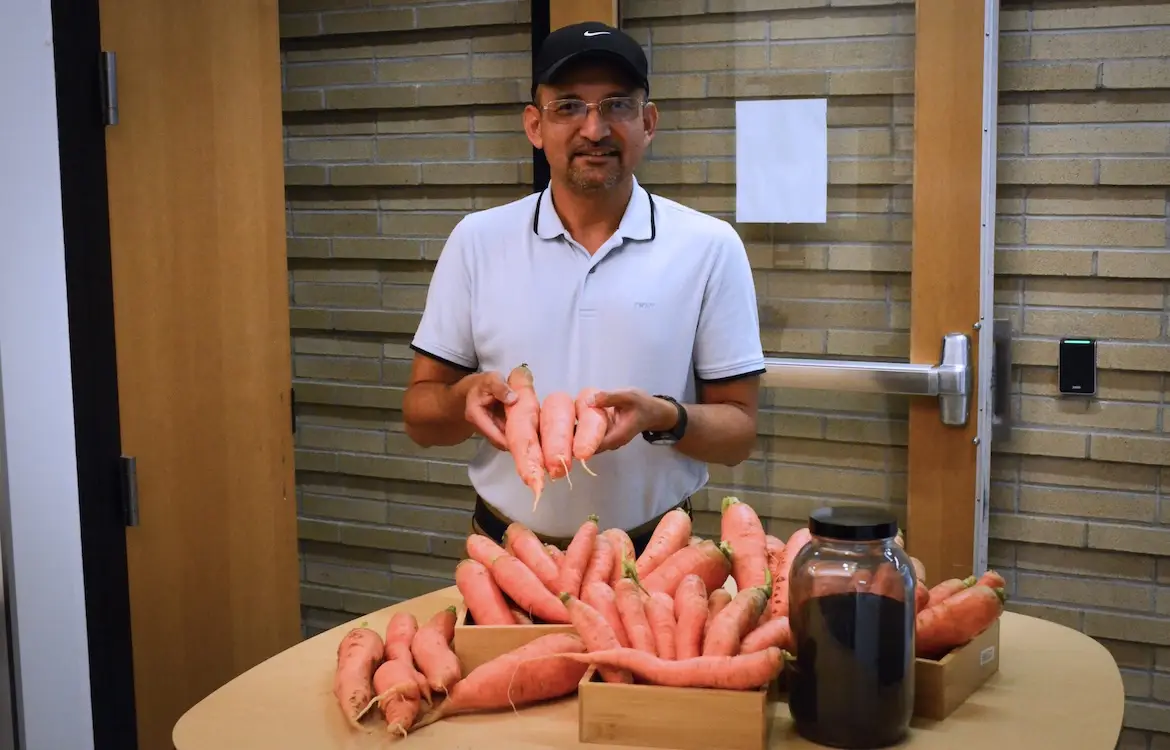

Jay Gatlin, a professor in the University of Wyoming Department of Molecular Biology, has been named the inaugural director of UW’s newly named Science Institute (SI).
SI is one of UW’s several universitywide institutes and centers. It enables world-class research and education that bring together disciplines across UW to strengthen the foundations of Wyoming’s present and future economy.

Under Gatlin’s direction, the institute will steward the mission and resources of the initiative, in addition to several extramural grants that support interdisciplinary convergence of sciences and engineering.
SI is organized as centers that address specific areas of relevance to Wyoming and UW, including science education at all levels; wildlife biology; materials research; controlled environment agriculture; quantum information sciences; engineering; and rural resilience. The projects supported by SI address areas of economic opportunity for Wyoming.
Additionally, the institute manages the UW Top-Tier Science Initiative and its programs, instrumentation, and plant and animal facilities.
“Jay brings a wealth of experience to this new position. Jay’s interdisciplinary education and his research expertise in areas crossing sciences and engineering will help him authentically foster convergence of disciplines through SI activities,” says Parag Chitnis, UW’s vice president for research and economic development, who heads the Research and Economic Development Division (REDD). “The state of Wyoming will benefit from newfound opportunities that SI-affiliated faculty will uncover and develop for the sake of making our state and its communities ever more vibrant, prosperous and competitive. Under Jay’s leadership, we expect that SI will enhance research and education activities that are Wyoming-relevant, nationally competitive, and globally recognized.”
“The potential of the Science Institute to positively impact people here at UW and, more broadly, across the state is truly exciting, and I am humbled by the opportunity to join a fantastic team dedicated to realizing the educational, outreach, and research missions of the institute,” Gatlin says.
Through integrated, interdisciplinary science, Wyoming’s current and future researchers and entrepreneurs revolutionize areas of Wyoming’s economy, which include mineral extraction, agriculture, tourism, resource management, and emerging technology. SI also serves to preserve Wyoming’s greatest natural resources and unique biodiversity. The institute strives to provide UW students with a flexible, pioneering skill set, giving them the resources to build a prosperous future for Wyoming and its residents.
About the University of Wyoming Research and Economic Development Division
REDD is a service organization to the faculty, staff and students of UW. Its goal is to provide swift, accurate and expert service to enhance the research missions of individuals and various units within the university. REDD empowers researchers, scholars, innovators and entrepreneurs with stewardship of expertise, interdisciplinary collaboration and transformational impact and prosperity for Wyoming and the world. To learn more, visit www.uwyo.edu/research.
This story was originally published on UW News.