


Type 1 diabetes is a disease that requires lifelong management. People with this condition do not produce insulin, a hormone that allows the body to take up sugars from blood and lower blood sugar levels. A lack of insulin results in high blood sugar, which can cause heart disease, nerve damage, blindness, and even death if left untreated.
Those with type 1 diabetes typically rely on artificial insulin delivered via a needle or an insulin pump to manage their condition. These invasive methods can be painful and inexact, as it’s difficult to pinpoint the correct amount of insulin to inject from moment to moment. In addition, insulin can be expensive.
But new research conducted by Oliver Trunschke, a PhD student in the UW Department of Molecular Biology, could lead to treatments for type 1 diabetes that are as easy and painless as flipping a light switch.
Blood sugar cycle
Type 1 diabetes is an autoimmune condition. It’s caused by the body’s immune system attacking and destroying healthy insulin-producing cells in the pancreas (beta cells).
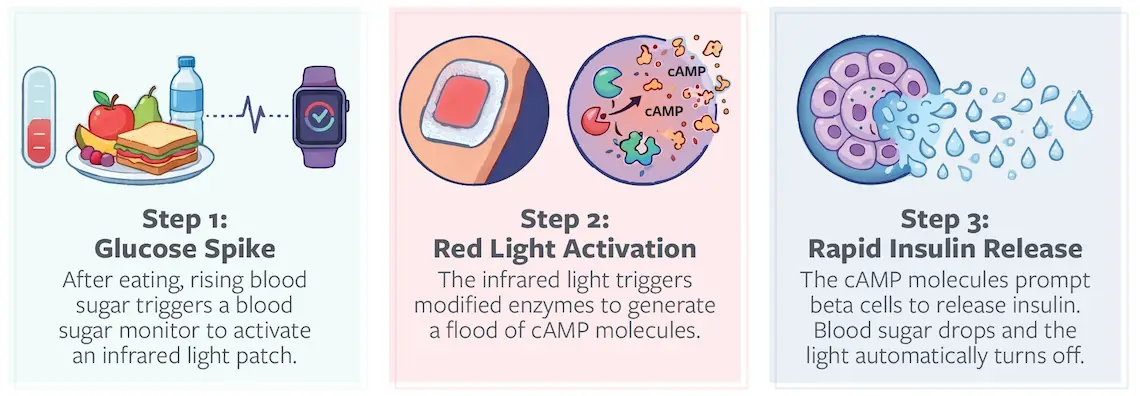
In a healthy body, blood sugar (glucose) spikes after a person eats food. High blood glucose triggers a molecular chain reaction that results in the production of cyclic adenosine monophosphate (cAMP) molecules. These cellular messengers signal the beta cells to release more insulin.
This insulin allows the body to absorb glucose from the blood. Blood glucose drops as the body converts glucose into other forms of energy for future use.
While beta cells might secrete a tiny amount of insulin without cAMP, an increase in cAMP significantly enhances the amount of insulin that beta cells release.
Transplant troubles
Some type 1 diabetes patients receive beta cell transplants, which allow their bodies to naturally produce insulin again.
These transplants require two donor pancreases to get enough functional beta cells, and sometimes multiple procedures are needed.
A transplant recipient’s immune system could destroy the transplanted cells, just like their immune system originally attacked their own beta cells. To address this risk, patients who receive transplants must take immunosuppressive drugs that increase the chance of becoming seriously ill from minor sicknesses.
Researchers have found a way to create a “biomembrane” around transplanted beta cells that prevents the immune system from attacking the cells without using immunosuppressive drugs. However, some of the beta cells inside the biomembrane do not receive adequate nutrition and oxygen, meaning that many of the cells within that biomembrane simply die off. The remaining living beta cells cannot produce enough insulin for the whole body.
That’s where Trunschke’s research comes in. He wants to design beta cells that could do twice as much work as regular beta cells. The tool that can give them this superpower is cAMP.
Targeted cAMPing sites
cAMP sends messages all over the body, helping the brain learn and remember, signaling the heart to beat, and even telling gut cells when to release fluid to help the gut move smoothly. Having too much cAMP in the wrong place could generate dangerous messages, like telling the heart to beat very quickly or signaling the gut to release a lot of fluid at once.
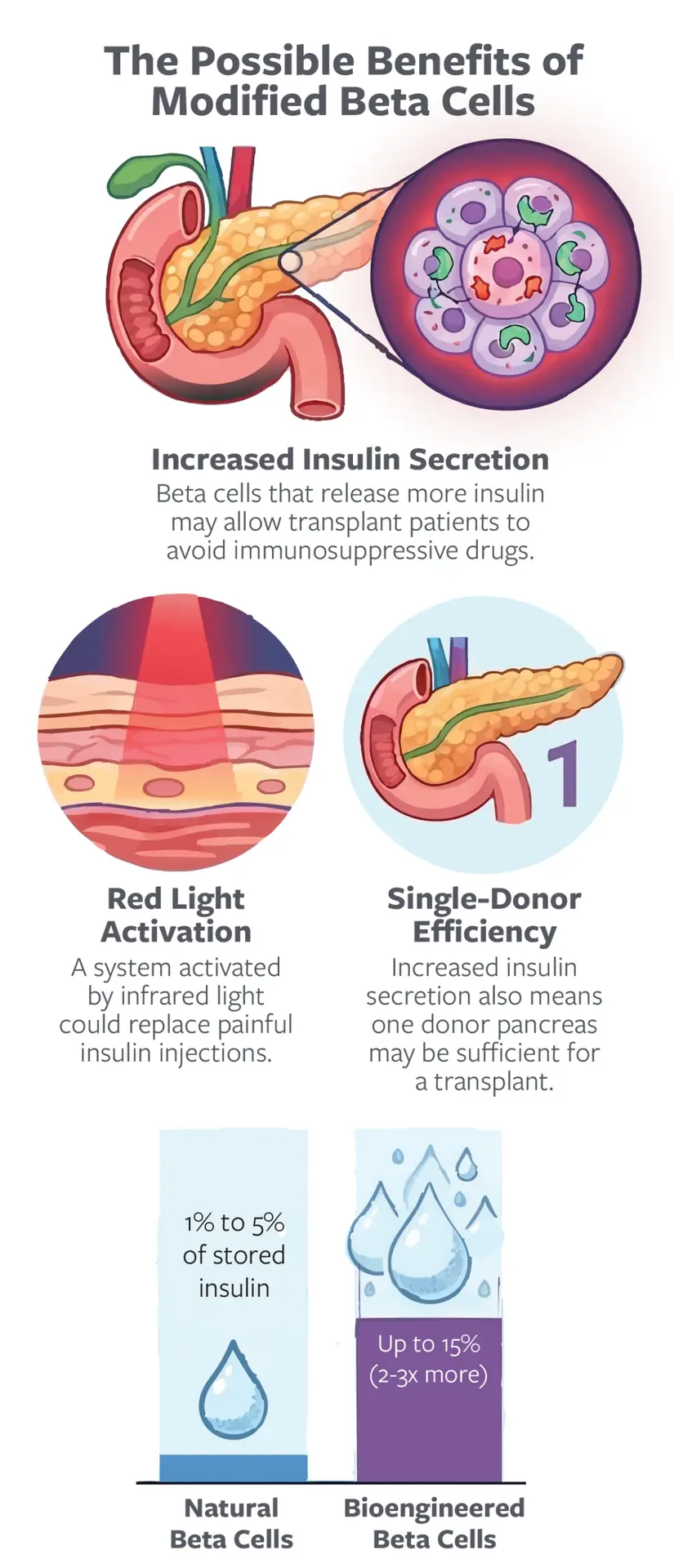
But flooding a targeted part of the body with cAMP could be a powerful tool. For example, exposing genetically modified beta cells to enough cAMP could help the cells release significantly more insulin.
Instead of the usual 1–5% of stored insulin that beta cells normally secrete in response to elevated blood sugar, researchers could potentially push the cells to secrete two to three times as much. Because each cell now secretes more insulin, far fewer cells are needed for a transplant, Trunschke explains. In turn, fewer cells mean the transplant survives longer and a single donor transplant may be sufficient.
However, natural processes within the body break down cAMP molecules. To trigger a large release of insulin, Trunschke needed to create many cAMP molecules very quickly.
To get the potent reaction he needed, he used a modified enzyme (adenylate cyclase) from Bordetella pertussis, the bacterium that causes whooping cough.
Many life forms, including humans, produce thousands of cAMP molecules in a second. But B. pertussis might generate millions of cAMP molecules in the same timeframe.
B. pertussis typically uses this flood of cAMP to overwhelm the cell signaling of a targeted human cell. Essentially, it’s as if the bacterium makes thousands of phone calls at once, crashing the human cell’s metaphorical phone tower. This paralyzes the human cell’s ability to fight infection, which ultimately leads to illness.
Trunschke has genetically engineered a B. pertussis enzyme that cannot cause illness but still produces large amounts of cAMP. In theory, this modified enzyme may help a limited number of beta cells produce enough insulin for the whole body.
But how can the body activate that enzyme at just the right time, when blood sugar is elevated?
As simple as flipping a light switch
Trunschke is working on bioengineering a B. pertussis enzyme that triggers cAMP production when it’s exposed to red light.
Why red light? If you’ve ever shined a flashlight through your thumb, you’ve probably seen the red light that makes it through your finger. Though the flashlight’s white light is made up of different wavelengths of light, the red light is best at moving through human tissues.
Trunschke envisions using this modified enzyme as part of a simple but powerful device that triggers insulin production. A red light activates when blood sugar is high. The red light causes modified B. pertussis enzymes to briefly generate a flood of cAMP molecules. These molecules then trigger increased insulin secretion from beta cells inside a protected biomembrane.
In theory, a light connected to a blood sugar monitor could automatically produce insulin without any needles, freeing up diabetes patients’ time and energy. This system could precisely control insulin levels by adjusting how long the light shines, shutting off production the moment enough insulin is present in the body.
In other words, “Picture a future where diabetes patients wear a credit-card-sized infrared light patch. Sugar climbs after lunch? The patch glows for 30 seconds—insulin surges, sugar drops, light off. No shots, no needles, no guesswork—just precise, painless, non-invasive control, switched on and off as easily as the lights in your home,” explains Trunschke.
It’s an appealing—and promising—vision, though Trunschke is still working to refine the approach. Currently, the B. pertussis enzyme produces some cAMP molecules even when it is not exposed to light, potentially secreting insulin when insulin is not needed.
Trunschke’s molecular tools are designed to target exactly where—and when—cAMP is created within the body. While he is investigating type 1 diabetes, his research could be useful for managing other diseases as well. Ultimately, his work could help researchers precisely control cellular functions like cell growth, learning and memory, and cardiac pacemaking, creating entirely new forms of light-controlled medicines.