



Whitebark pines tend to grow slowly and live long, sometimes surviving for more than 1,000 years. Unlike most trees, they thrive in cold, windy subalpine environments.
But, despite their historic longevity, the future of these fascinating trees is uncertain. In addition to their susceptibility to scourges like white pine blister rust, whitebark pines are highly sensitive to environmental changes. As extreme weather events increase in both frequency and severity, whitebark pine populations have grown increasingly vulnerable to extinction.
According to a new study led by UW researchers, this heightened risk is partly because many different white-bark pine populations are responding to environmental changes in sync. The researchers found that as events like widespread drought have grown more common, growth patterns in whitebark pines across the Sierra Nevada range have become increasingly synchronous.
The problem with synchrony
The new study quantified what’s known as spatial synchrony, analyzing to what extent geographically distinct populations of trees responded similarly to change. In this case, the researchers focused on how tree populations responded to fluctuations in temperature and precipitation.
“Spatial synchrony arises when dynamics between these populations—for instance, growth patterns—fluctuate in unison through time,” says Kaitlyn McKnight, a PhD student in the botany department who led data analysis for the study. “If you have separate populations operating in synchrony, there’s the possibility that they will simultaneously collapse, whereas if they’re operating asynchronously, one population might be declining, but another population might be increasing.”
For example, if extreme drought conditions persisted across an entire region, tree populations growing synchronously across that region would experience concurrent declines. As such events become more common, regional populations could decline dramatically, even if some smaller, less synchronized populations managed to weather the drought conditions. These effects could be exacerbated in the future if factors like variable winter precipitation or higher summer temperatures are triggering increased growth synchrony.
“Even if populations don’t all crash together, our results show they’re all likely responding to the same environmental drivers,” says Lauren Shoemaker, an assistant professor in UW’s botany department. “That’s concerning from a conservation standpoint because if they’re all operating together, a drought could knock them all back at the same time. It means that local extinctions could become regional, or even occur across species.”

Time travel through tree rings
Previous studies have shown that environmental conditions, including temperature and precipitation, affect spatial synchrony. Shoemaker and McKnight built upon these findings to investigate how changes in precipitation and temperature over the past century drove changes in tree growth synchrony.
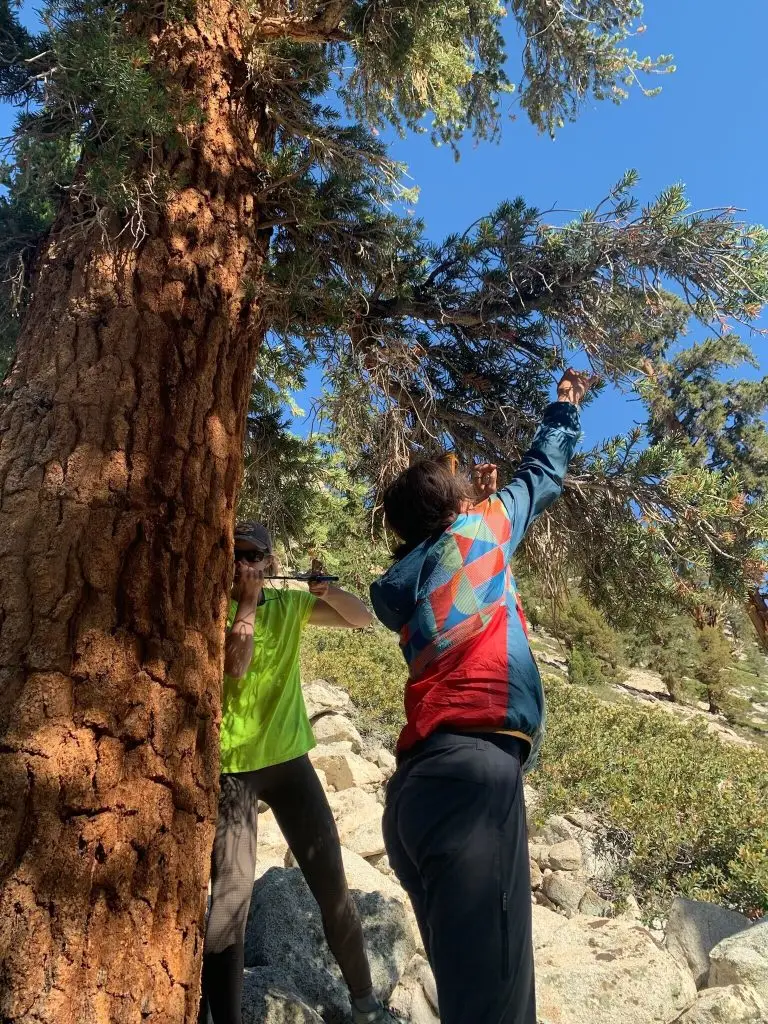
To assess changes in spatial synchrony over time, they studied 20 geographically distinct populations of whitebark pines across the Sierra Nevada range. The study spanned more than a century of tree growth as well as hundreds of kilometers of mountainous terrain.
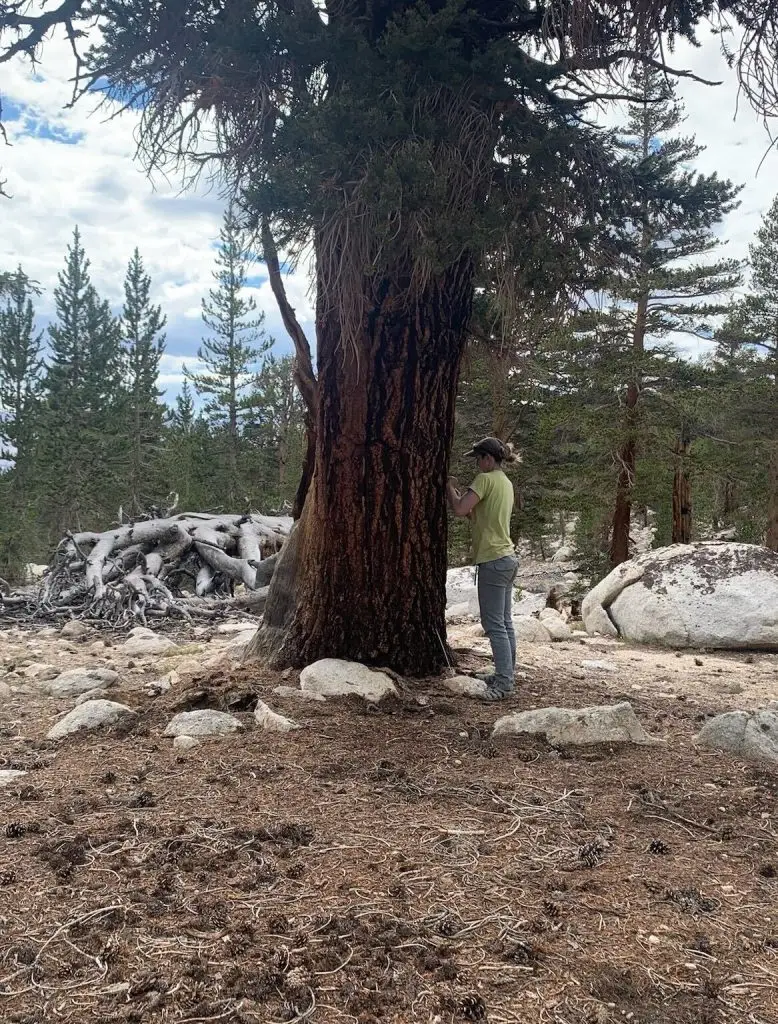
McKnight analyzed 118 years of tree-ring data collected by researchers at the University of California, Santa Barbara, and University of California, Davis, from more than 320 whitebark pines. She also obtained data on annual winter precipitation and summer temperatures from local weather stations across the study period.
Then, she crunched the numbers. Using a statistical tool known as wavelet analysis, McKnight quantified how temperature and precipitation influenced growth synchrony over time.
Ancient trees, modern analysis
“Wavelet analysis is borrowed from physics and mathematics. It’s basically a way to break down time series data—in this case, from tree rings—so that we can look across different time scales,” McKnight explains. “We’re able to capture how synchronous the 20 populations are with one another across our entire time series from 1900 to 2018, at different scales of time.”
Within the study period, McKnight examined 10-year, 20-year, and 30-year intervals to detect patterns that might not have been noticeable across annual periods. Ultimately, she found that synchrony in whitebark pine growth across the 20 populations has increased dramatically in recent decades.
“We found evidence of increased synchrony, particularly in the latter half of the time series, about 1950 onwards. These increases were particularly seen on decadal and multi-decadal timescales,” she comments.
McKnight’s results also suggested that precipitation and temperature influenced changes in tree growth synchrony—an observation that may not bode well for whitebark pines if extreme weather events and rising summer temperatures grow more common.
“The story with precipitation was really clear, where we saw increases in precipitation synchrony driving increases in growth synchrony,” she notes.
The pattern with temperature wasn’t quite as simple, as the researchers did not observe increases in temperature synchrony. Instead, they discovered an indirect pattern correlating increasing summer temperatures with increased precipitation synchrony. “Temperature is also driving growth synchrony, but it’s doing so indirectly through its relationship to precipitation synchrony,” McKnight explains.
In the face of current and predicted climatic changes, these findings aren’t great news for the whitebark pine, which is already listed as endangered.
For land managers, though, studies of spatial synchrony may be useful in targeting conservation efforts. “If there’s options for where you put your money, you might want to choose the population that’s least synchronous with everything else since it is responding differently,” Shoemaker notes. “This could indicate differences in microclimate conditions that can buffer the response of the trees to future changes in environmental conditions.”

Going global
Unfortunately, whitebark pines in the Sierra Nevada range probably aren’t the only trees whose extinction risk may increase due to spatial synchrony. With that in mind, McKnight is extending the analysis to include 89 different tree species around the world.
With access to global datasets, she says, “we can look even further back in time, so we can study historic synchrony patterns and see how they’re different from current patterns. For some of these species, you can go back a thousand years or even older.”
To learn more, contact Shoemaker at lshoema1@uwyo.edu.
This article was originally published in the 2025 issue of Reflections, the annual research magazine published by the UW College of Agriculture, Life Sciences and Natural Resources.