
Bailey Yeager’s path to conservation began at the Johnson County Fair, where showing sheep taught her responsibility, animal care, and the value of community support. Now in her second year studying rangeland ecology and watershed management at the University of Wyoming, she’s preparing to give back to the rural communities that shaped her.
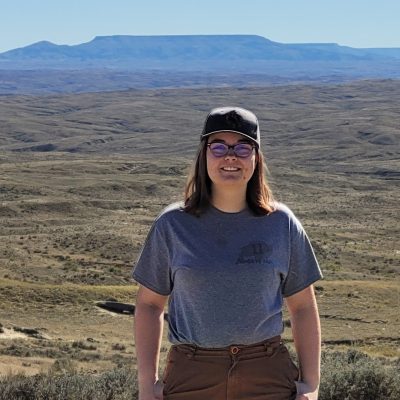
“Buffalo has a really big appreciation for agriculture, and that was such a big deal for me,” Yeager says. “The Johnson County Fair was the highlight of my summer every year.”
Those early experiences in 4-H and FFA, combined with supportive teachers, set Yeager on her current path in UW’s Haub School of Environment and Natural Resources, where she has a concurrent major in environment and natural resources.
“I was allowed to start taking college courses my sophomore year of high school,” she says. “I took a range and environmental science course, and knew this is what I want to do with my life.”
Selected to be a UW Tomé Scholar, Yeager received a full-ride scholarship and funding for experiential learning opportunities that opened doors she never imagined. That scholarship led to the highlight of her college experience: traveling to Mongolia last summer as part of the Haub School’s Wild and Working Lands course, led by Haub School Dean John Koprowski.
“I’d never been abroad before,” Yeager says. “It took a lot of planning and courage, but I got to experience a different environment and culture. It’s an experience I’m going to remember forever.”
The Haub School’s interdisciplinary approach has transformed Yeager’s professional development.
“There are so many different perspectives on one issue. You have to do a multifaceted approach,” she says. “The Haub School has made me a better critical thinker, a better communicator, and better at research.”
After graduation, Yeager plans to pursue a master’s degree and work in rangeland monitoring, environmental surveying, or agricultural research to support the rural communities she grew up in.
“I really want to encourage sustainable land management and support the people who rely on these lands,” she says. “I hope to help rural communities, because I grew up in one. I will always hold love for them, and it’s something we see so often ignored.”
For more information about the Haub School, see the original version of this article published on UW News.