


Fishing tourism is an important industry in Wyoming, generating millions of dollars of income in Teton County alone.
The University of Wyoming Extension recently released a free digital publication to assess the future of this vital industry. The new publication is titled “How Climate May Affect Angler Trips and Expenditures in Teton County, Wyoming.” It is especially relevant to Wyoming outfitters, business owners, city planners, and others who are impacted by fishing tourism.
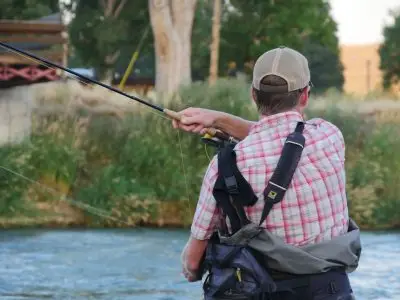
“The way I think about it is adapting to create an experience that is still attractive to a lot of anglers, even given changes that may come to pass,” says Patrick Hofstedt, lead author of the publication.
The researchers used a survey to investigate what current Teton County anglers value in their fishing trips. Then, they projected how Teton County angler spending might change in three climate scenarios identified by Wyoming Anticipating Climate Transitions (WyACT), a project led by UW and funded with a National Science Foundation grant.
In the “Shrinking Snowpack” scenario, less snow leads to warmer water and earlier peak runoff. These conditions are likely to result in fewer fish overall and particularly fewer Yellowstone cutthroat trout, which many anglers visit Teton County to catch.
In the “Warm Refuge” scenario, Teton County is less affected by climatic changes than other areas in the West, resulting in more crowded fishing spots. Finally, in the “Hot and Smoky” scenario, Wyoming experiences more wildfires than in the past and temperatures rise.
The researchers found that some anglers would stop fishing in Teton County in all three climatic scenarios. The “Hot and Smoky” scenario is projected to cause the largest loss in fishing tourism expenditures, since wildfire smoke is a major deterrent for most anglers, particularly anglers from out of state. In contrast, in the “Warm Refuge” scenario, Teton County might lose some anglers who prefer isolation, but anglers who prefer easy-to-access fishing spots might plan more fishing trips.
The researchers also analyzed how municipalities and businesses could mitigate economic losses in each of the climate scenarios. For example, Teton County might consider working to maintain Yellowstone cutthroat trout populations. Outfitters could plan trips to more isolated areas, or diversify their incomes rather than relying solely on fishing trips.
To view the new publication, visit https://bit.ly/angler-economics. Contact Hofstedt at phofsted@uwyo.edu with questions.