

UW Extension Offers New Educational Series on Ranch Economics, Natural Resource Management

The University of Wyoming Extension has launched a new educational series designed to support ranchers in navigating the complexities of modern livestock and land management. Rancher’$ E.D.G.E. (Excellence in Development, Grazing and Economics) is designed for ranchers, family members, and employees actively involved in the management and care of a ranching operation.
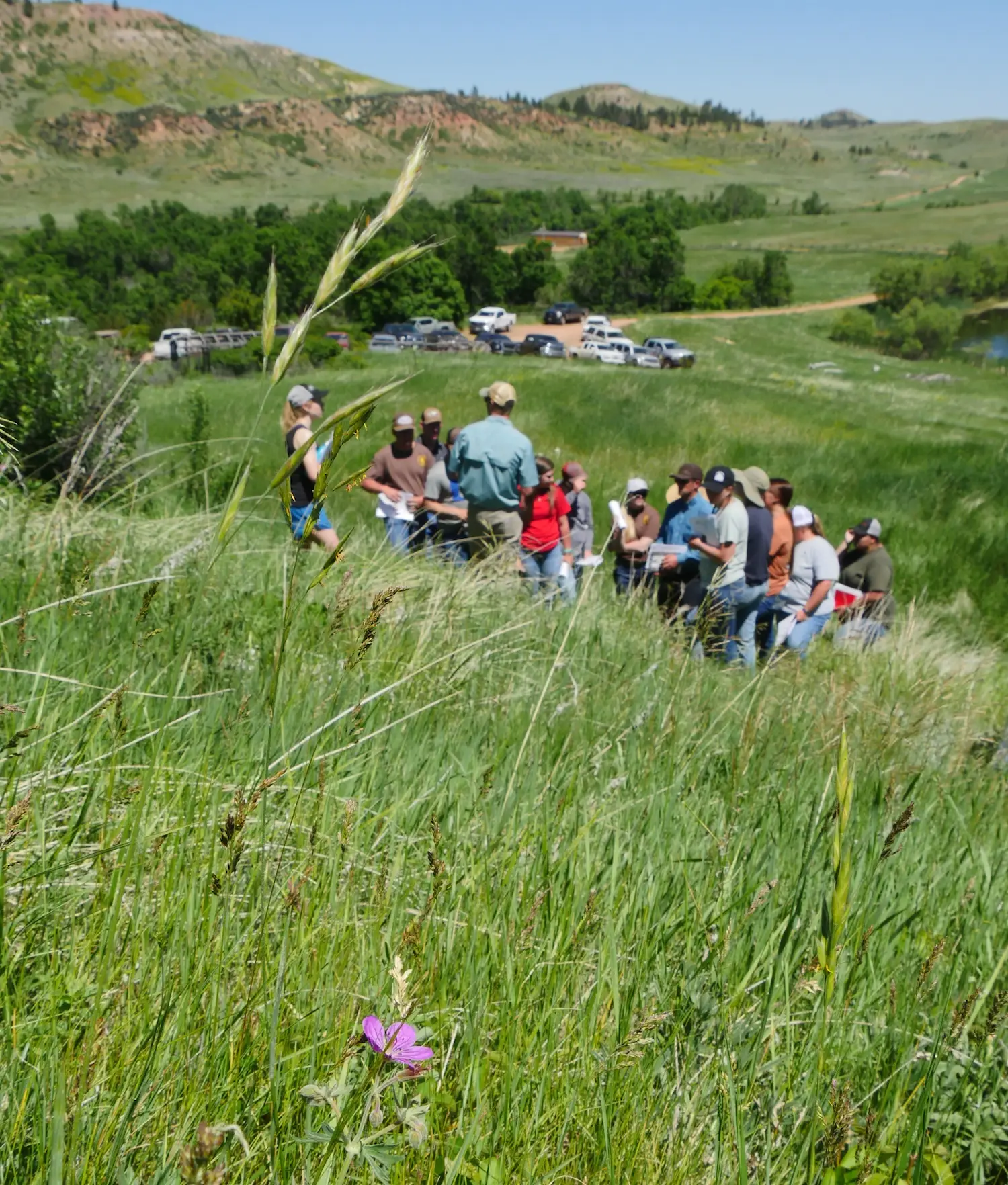
group of people gather around a presenter on a grassy hillside with a cluster of vehicles beside green trees below and a slope with red rock in the background
Attendees of Extension’s Ranch Camp program learn about rangeland plants and soils on a hillside northeast of Sheridan.

“Rancher’$ E.D.G.E. equips participants with the tools and knowledge needed to make informed decisions and enhance the sustainability of their operations,” says Jedidiah Hewlett, a UW Extension educator based in Converse County. “With high input costs, unpredictable weather patterns, and evolving market conditions, staying informed and adaptable is more critical than ever.”

The Rancher’$ E.D.G.E. curriculum is tailored to promote a holistic mindset and practical application of knowledge. The program is offered as three unique sessions throughout the year, providing a multi-season perspective on the ranching production cycle.

Each session features a mix of classroom instruction and hands-on field activities covering topics such as risk management, marketing strategies, livestock nutrition, ration balancing, body condition scoring, and range management.

In addition to gaining valuable insights from a team of UW educators, participants will have the opportunity to network with fellow ranchers.

The next Rancher’$ E.D.G.E. session will be held in Thermopolis, beginning at 1 p.m. Tuesday, June 24, and concluding at noon the following day.

The cost of attendance is $250 per person for each session, which includes a packet of materials, snacks, and a complimentary dinner with presenters. Attendees are responsible for their own lodging, travel, and additional meals.

To register, visit tinyurl.com/RanchersEDGE. The registration deadline for the June event is Tuesday, June 10. Space is limited.

The final 2025 Rancher’$ E.D.G.E. session will be held in Laramie November 18–19. While attending every session is not required, it is encouraged for the most robust learning experience.

For more information, contact Hewlett at jhewlett@uwyo.edu or (307) 358-2417.

Share the Post:

Related Posts

Artist booth at an Ag & Art Tour event, where a local artist displays watercolor paintings and handmade prints while engaging with a visitor; set outdoors with rural landscape, showcasing the connection between agriculture, creativity, and community.

UW Extension to Host Ag & Art Tour in Natrona County

For those interested in connecting with local artists and agriculturalists, the University of Wyoming Extension will lead a series of free self-guided Ag & Art tours from May through September.
The first Ag & Art event takes place in Natrona County Saturday, May 16, from 10 a.m. to 2 p.m.
“We had a great season last year and are excited to bring this event to five counties this summer, kicking things off [in] Natrona County,” says Hailey Sorg, Wyoming’s Jay Kemmerer Outdoor Recreation, Tourism and Hospitality (WORTH) Institute extension educator.

Read More
Amy Storey, a University of Wyoming third-year master’s student in zoology and physiology, completes a field survey for a collection site in Grand Teton National Park. This included taking habitat measurements about the floral and bee community as well as collecting environmental data, such as wind speed and land use. Storey’s presentation, titled “Parasites and Bumble Bee Decline in Wyoming,” was named the winning entry for a master’s student at the Wyoming Chapter of the Wildlife Society meeting in Sheridan April 8. (Rebecca Armentrout Photo)

UW’s Storey Makes Winning Presentation at Wyoming Chapter of Wildlife Society Meeting

Wild bumble bees are in decline, and various parasites may be a major cause. But there hasn’t been any data on whether Wyoming bees have parasites and to what degree—until now.
Amy Storey, a University of Wyoming third-year master’s student in zoology and physiology, shed light on her research when she took center stage at the recent Wyoming Chapter of the Wildlife Society meeting in Sheridan.

Read More

Help us improve this website!

We’re working to make AgNews easier to use and more useful for you. This quick survey takes about 1–2 minutes.