


Two University of Wyoming faculty members will study how to understand the microcircuit changes that occur in the brain’s prefrontal cortex during normal aging as well as disease progression in Alzheimer’s disease.
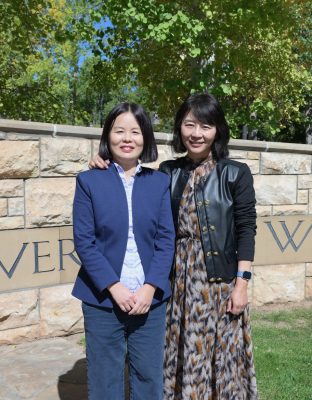
To help them conduct this research, Rongsong Liu, a professor in the Department of Mathematics and Statistics and in the Department of Zoology and Physiology, and Yun Li, an associate professor of neuroscience in the Department of Zoology and Physiology, recently received a two-year $385,610 grant from the National Institutes of Health (NIH).
The NIH Exploratory/Developmental Research Grant (R21) was awarded for their project titled “Integrating Experimental and Computational Models to Study the Prefrontal Microcircuit Changes During Aging and Alzheimer’s Disease.” The grant began Sept. 1 and runs through June 30, 2026.
The R21 grant is intended to encourage exploratory/developmental research by providing support for the early and conceptual stages of project development.
Microcircuits in the brain’s prefrontal cortex play essential roles in planning, reasoning, decision-making, and problem-solving. Disruptions in prefrontal microcircuits are associated with behavioral abnormalities in a variety of brain disorders, including Alzheimer’s disease.
“Functional magnetic resonance imaging studies have suggested disruptions among different brain regions in Alzheimer’s disease patients,” Li says. “However, prefrontal cortex microcircuit changes during normal aging and Alzheimer’s disease initiation and propagation, and how these changes relate to cognitive dysfunctions in Alzheimer’s disease, are poorly understood.”
The research will integrate empirical calcium imaging recordings from live mice, virtual simulation models, and neural decoding to determine and predict microcircuit changes in the prefrontal cortex during healthy aging and disease progression in Alzheimer’s disease, according to Liu and Li.
The grant is a collaboration with Rong Chen, an associate professor in the School of Medicine and associate vice chair of artificial intelligence at the University of Maryland. Li, Liu, and Chen will serve as the grant’s co-principal investigators (PIs). Li is the grant’s contact PI.
The grant will focus on interdisciplinary collaborations among applied mathematics, machine learning, and experimental neuroscience, with the research to take place at both UW and at the University of Maryland, Liu says.
The multidisciplinary approach to the research will capitalize on Li’s miniscope in vivo calcium imaging expertise; Liu’s work in simulation modeling and graph theory-based network analysis; and Chen’s proficiency in neural decoding.
According to the grant abstract, real-time calcium imaging of mice behavior makes it possible to directly study the prefrontal cortex microcircuit changes during aging and dementia. Calcium imaging-based neural decoding is a powerful multivariate approach with the capability of efficient annotation and model transferability. Simulation modeling helps to tease out the primary degeneration and secondary compensatory effects on a microcircuit.
“We believe that our strategies will revolutionize our understanding of aging and Alzheimer’s disease progression and help develop new effective treatments for Alzheimer’s disease,” Li says.
The R21 grant provides funding for four UW graduates students—two in neuroscience and two in mathematics—and two UW undergraduates majoring in biology/physiology.
“We believe that this project aligns well with the university’s commitment to students having a wealth of research opportunities across disciplines,” Liu says.
A Phase II R33 grant—worth nearly $2.2 million over three years—is contingent upon completion of proposed milestones under the original R21 grant as well as program priorities and fund availability, Li says. The R33 grant would provide support of innovative exploratory and developmental research activities initiated under the first grant. The second grant, if secured, would run from July 1, 2026, through June 30, 2029.
Li’s research program focuses on studying functions and dysfunctions of the prefrontal cortex. She received her Ph.D. in physiology from the University of Texas-San Antonio and her master’s degree and bachelor’s degree in biology, both from the University of Science and Technology of China in Hefei, China.
Liu’s interests are mathematical biology, differential equations, dynamical systems, and their interface. Her research projects involve formulation, analysis, and applications of deterministic mathematical models for infectious diseases, ecological systems, and neural networks.
Liu received her Ph.D. in mathematics from York University in Toronto, her master’s degree in mathematics from Fudan University in Shanghai, China, and her bachelor’s degree in mathematics from Henan Normal University in Xinxiang, Henan, China.
This story was originally published on UW News.