


Nine years ago, University of Wyoming entomologist Scott Shaw and colleague Eduardo Shimbori gained a moment of fame by naming several newly discovered South American insect species for celebrities — including a wasp for singer and musician Shakira (Aleiodes shakirae).
Today, the Shakira wasp is one of only 18 animal species featured in a museum exhibition in Denmark. “From Rock Fossils to Pop Insects” at the Naturama Museum in Svendborg, Denmark, highlights species named after famous rock musicians and pop stars, including an ancient mammal for Mick Jagger (Jaggermeryx) and a deep-sea crab named for Metallica (Macrostylis metallicola).
The exhibition was planned and created by Thomas Berg, a senior scientist and curator at the museum.
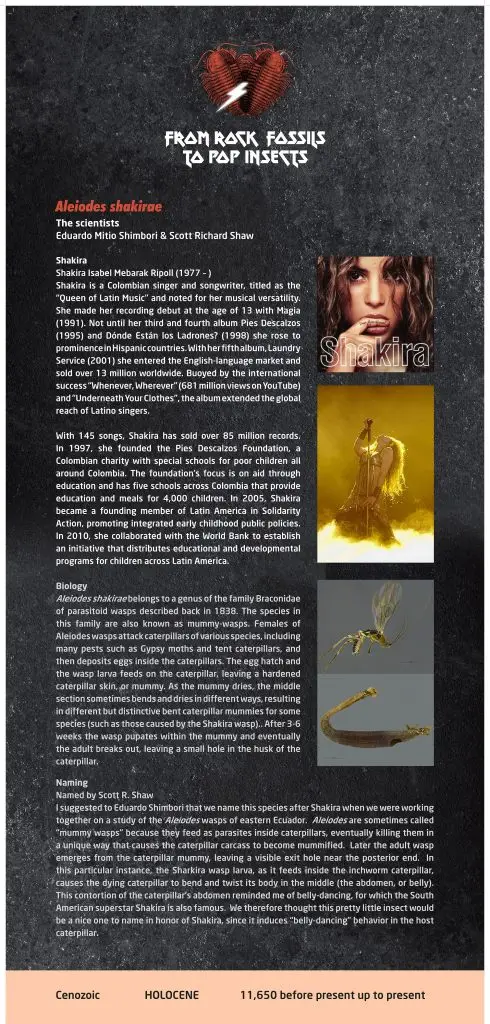
“Discover the fascinating old fossils, listen to the music and find out why scientists use rock music when naming fossils,” says a Naturama website promoting the exhibition, which is open to the public for viewing through November.
The Shakira wasp is a parasite of caterpillars, feeding and developing inside them — and causing them to bend and twist their abdomens in a distinctive way, which reminded Shaw and Shimbori of belly dancing, for which the Colombia-born singer also is famous. The Shakira wasp and other insect species were described in a 2014 volume of the international research journal ZooKeys, which is dedicated to advancing studies of the taxonomy, phylogeny, biogeography and evolution of animals.
“It’s gratifying to see our discovery included in this exhibition in such a creative and artistic way,” Shaw says. “I hope this public attention will help to draw new students to studies of tropical insects and the urgent field of tropical forest conservation.”
Berg says he chose the Shakira wasp for the exhibition because Shakira is a world-class singer and musician — and because of the researchers’ story behind the naming of the insect.
“Shaw and Shimbori’s personal story was captivating, with clear references to the parasitic wasp’s effect on its victim,” Berg says. “I’ll also admit that I’m a huge fan of Shakira, and it was such a gift to have the world’s best argument to include Aleiodes shakirae in the exhibition.”
National Science Foundation-funded fieldwork conducted in the cloud forests of eastern Ecuador by Shaw and colleagues led to the discovery of 24 new species of Aleiodes wasps that mummify caterpillars. Some of these were named for other celebrities, including Jimmy Fallon, Jon Stewart, Stephen Colbert and Ellen DeGeneres. One of these, Aleiodes colberti — named after Colbert — was featured on the Jan. 22, 2022, segment of Colbert’s “Late Show” on CBS.
A UW faculty member since 1989, Shaw is the curator of UW’s Insect Museum in the College of Agriculture, Life Sciences and Natural Resources. He received that college’s Vanvig Lifetime Achievement Award in 2018. He has published more than 200 scientific publications about insects as well as a book, “Planet of the Bugs: Evolution and the Rise of Insects,” which tells of dominant insect species and how they shaped life on Earth.
This story was originally published on UW News.