


How do plants make a living? Some plants are gamblers, while others are swindlers. Some plants are habitual spenders, while others are strugglers and miserly savers. Plants have evolved a spectacular array of solutions to the existential problems of survival and reproduction in a world where resources are scarce, disturbances can be deadly and competition is cutthroat.
This is the description of a new book titled “Plant Strategies: The Demographic Consequences of Functional Traits in Changing Environments” that explores this question. The book is written by Daniel Laughlin, a professor in the University of Wyoming Department of Botany and director of the Global Vegetation Project. The book, published by Oxford University Press, was released July 27 in the U.K. Books will ship to the U.S. over the next month or so. The 464-page book is targeted to graduate students and other scholars of ecology and evolution.
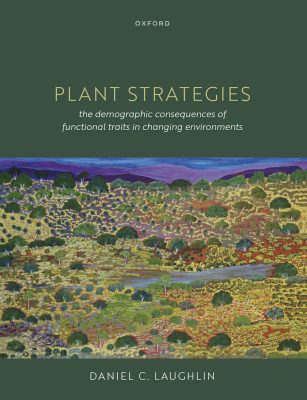 “The goal of this accessible book is to articulate a coherent framework that unifies life history theory with comparative functional ecology to advance prediction in plant ecology,” Laughlin says. “Armed with a deeper understanding of the dimensionality of life history and functional traits, we are now equipped to quantitively link phenotypes to population growth rates across gradients of resource availability and disturbance regimes. Predicting how species respond to global change is perhaps the most important challenge of our time.”
Laughlin’s laboratory develops quantitative approaches to understand and predict how plant species and communities respond to global change. He currently teaches courses in ecological modeling and vegetation ecology and is associate editor of Ecology and Ecological Monographs.
Laughlin’s book already has received positive early reviews from academics around the globe.
“This book is remarkable for the enthusiastic treatment of not only the critique of published ideas about plant strategies, but also the wide range of studies that underpin those ideas,” says Peter Grubb, a professor emeritus in the Department of Plant Sciences at the University of Cambridge. “The author seems equally at home as he reviews relevant findings — and gaps in understanding — in areas as different as plant morphology and physiology on the one hand and demography, evolution and game theory on the other.”
“A stout-hearted trek through the rugged landscape of plant ecological strategies, species traits and how they translate into demographic success in some settings but not others,” says Mark Westoby, a professor emeritus in the Department of Biological Sciences at Macquarie University in Sydney, Australia. “The writing is energetic and richly illustrated; Laughlin must be a lively teacher! An excellent read for research students and discussion groups.”
This story was originally published on UW News.