



UW Extension publication explains spruce tree winter injuries

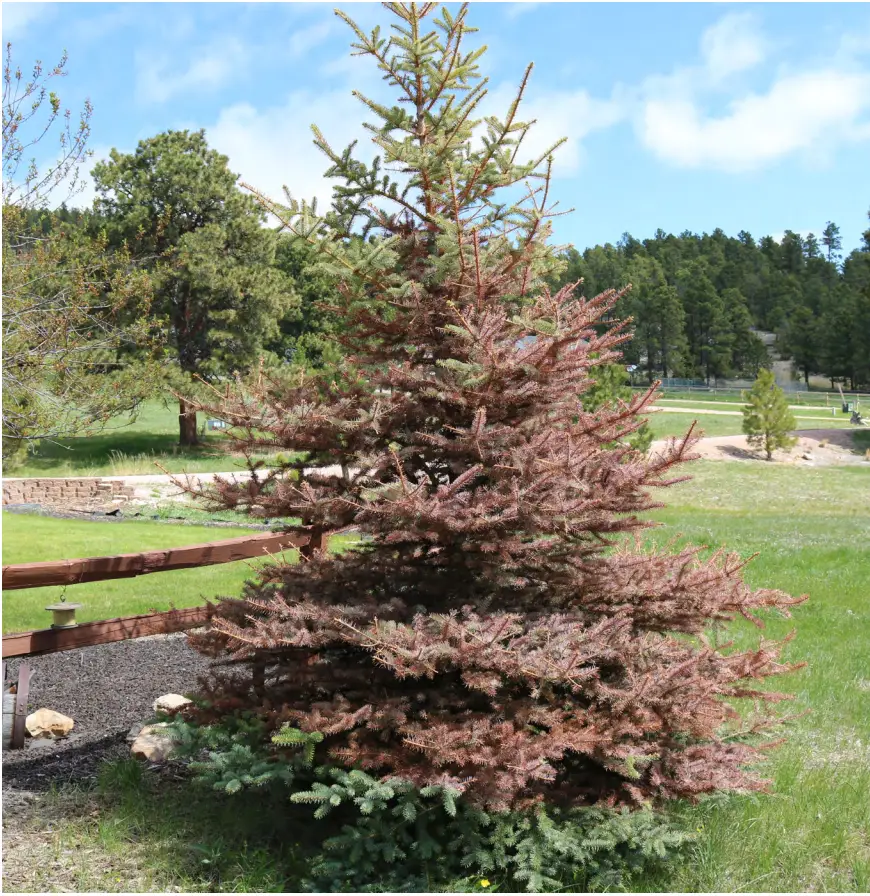
Spruce tree with browning needles
Typical Spruce tree winter injury symptoms. 

Each spring people across Wyoming notice injuries in their evergreen trees and shrubs from the long winter.

“Winter injury appears as dead, brown or purple discoloration in the needles of evergreen trees and shrubs, and it often shows up in the spring,” said Chris Hilgert, University of Wyoming Extension state Master Gardener program coordinator.  “Winter injury to spruce is the most common, but we also see winter injury in pine, fir and juniper.”

Winter injury can be a result of extreme cold temperatures, drought stress, winter desiccation (cold dry winds draw moisture out of the needles when the ground is frozen and unable to replace moisture) or a combination of these problems, said Hilgert.

Evergreens, ideally, should be watered year-round including during a winter thaw, said Hilgert.

For more information about winter injury to spruce trees, check out Spruce Trees Winter Injuries at https://bit.ly/wyo-spruce. The UW Extension publication is available for free viewing and download in pdf, HTML or ePub formatting.

For more information, contact Hilgert at chilgert@uwyo.edu.

 

Share the Post:

Related Posts

Jennifer Bell.

UW Works with Wyoming DEQ-AML, UR Energy on Soil Reclamation Project Using Coal Char

The Wyoming Department of Environmental Quality Abandoned Mine Lands Division (WDEQ-AML), UR Energy USA, and the University of Wyoming have formed a collaborative five-year research partnership to advance soil health and mine reclamation technologies. The project evaluates innovative soil amendments, including state-produced coal char, to accelerate the restoration of disturbed lands to productive native rangelands across Wyoming.

Read More

UW Researchers Use Graph Theory to Study Autism in Mice

Just as a city cannot be understood by studying individual buildings without considering the roads connecting them, the brain cannot be fully comprehended by examining individual neurons without studying how they work together as a network.

This is how Rongsong Liu, a professor in the University of Wyoming Department of Mathematics and Statistics and the Department of Zoology and Physiology, views the work she and other researchers conducted using graph theory to better understand autism spectral disorder (ASD) in mice.

Read More